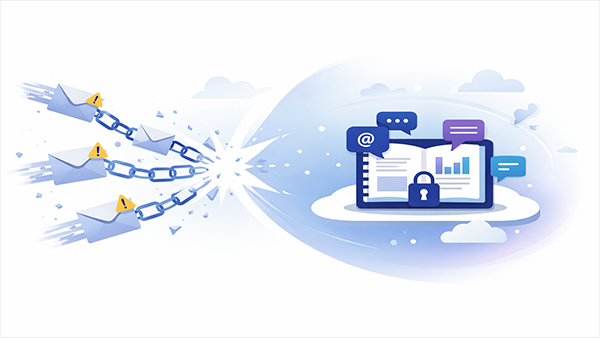
If you’ve ever searched your inbox for “that one attachment from three weeks ago”, you already know the problem.
Researchers collaborate constantly, across labs, institutions, and even countries, but too often that collaboration happens through long email threads, unsecured attachments, and multiple file versions labeled final_v3_REALLYfinal.xlsx. Beyond the frustration, this approach creates serious risks for data security, version control, and compliance.
There’s a better way to collaborate, one that keeps your data secure, your team aligned, and your research moving forward.
The Risk of Email-Based Collaboration in Research
When research data is shared through email, teams face immediate challenges:
- Loss of control once files are downloaded or forwarded
- Multiple versions of the same dataset circulating simultaneously
- Disconnected conversations separated from the experimental record
- Compliance and IP risk when sensitive data leaves controlled systems
LabArchives addresses these issues by keeping all research data, documentation, and collaboration activities within the ELN, where access, changes, and discussions are fully auditable.
Secure Sharing with LabArchives Permissions
Research collaboration requires flexibility, but not unrestricted access. Not every collaborator needs visibility into an entire notebook.
LabArchives enables secure, permission-controlled sharing by allowing teams to:
- Share specific notebooks, folders, or individual entries
- Assign role-based access (view, comment, or edit)
- View collaborators’ notebooks and data in real time, without waiting for updates
By allowing researchers to peer directly into shared notebooks, everyone stays in the loop on progress and results, eliminating the need to request updates and keeping teams continuously aligned.
Collaborating with Microsoft Tools Inside LabArchives
Research teams often rely on Microsoft Word, Excel, and PowerPoint to draft protocols, analyze data, and prepare figures, but sharing these files through email or disconnected storage introduces risk.
LabArchives enables secure collaboration on Microsoft files by allowing teams to:
- Create and edit Word, Excel, and PowerPoint files using Microsoft Office for the Web directly within the ELN
- Collaborate simultaneously on documents in real time
- Maintain version history and auditability as part of the research record
Microsoft files remain centralized, governed, and fully auditable within LabArchives, reducing file sprawl while preserving data integrity, security, and compliance.
Collaborate in Context with Comments and @Mentions
Collaboration is about more than file access, it’s about clear, timely communication tied to the work itself.
LabArchives enables real-time, in-context collaboration by allowing teams to:
- Comment directly on notebook entries, data, or files
- Use @mentions to notify collaborators instantly
- Keep discussions permanently linked to the research record
This eliminates side conversations in email, creates a single source of truth for both data and discussion, and provides clear context for conversations regarding the data.
Guest Access for External Collaborators
Research rarely happens in isolation. Collaborating with external partners, CROs, or consultants often requires data sharing, but not full notebook access.
LabArchives Guest Access enables secure collaboration beyond your organization by allowing you to:
- Invite external users to specific notebooks or entries
- Restrict visibility to only shared content
- Maintain full ownership and control of your data
Guest collaborators work directly within LabArchives without requiring a subscription, reducing file exports while preserving data integrity, security, and IP protection.
Built-In Versioning and Audit Trails
Unlike email attachments, LabArchives automatically maintains:
- Version history for notebook entries
- User attribution for edits and comments
- Time-stamped activity logs
This built-in auditability supports research integrity, reproducibility, and compliance requirements, without adding administrative burden to researchers.
The Value: Collaboration without Compromise
By replacing email-based sharing with LabArchives collaboration features, research teams gain:
- Stronger data security through controlled access
- Faster collaboration with real-time, in-context communication
- Clear accountability through versioning and audit trails
- Simplified workflows with everything in one platform
With LabArchives ELN, collaboration becomes easier, safer, and more efficient, so teams can focus on discovery instead of tracking files and emails.

 Record, organize, search and share your scientific data
 Streamline organizing, tracking and ordering lab inventory
 Manage and schedule lab equipment and resources
 Secure, compliant, government-approved solution