ELN stands for Electronic Laboratory Notebook. That middle word ‘laboratory’ comes with a STEM connotation. It makes many think of beakers, flasks, white lab coats, the periodic table and those Bunsen burners you could never light in your high school chemistry class. Labs, however, aren’t just for science.
Merriam Webster defines a lab as a “a place providing opportunity for experimentation, observation, or practice in a field of study.” Labs, research and data are all found in the humanities, too.
Hannah Gunderman, Cultural Geographer and Research Data Management Consultant at Carnegie Mellon University Libraries, does research that is a near perfect example of this. She studies science fiction films, TV shows and their underlying messages and documents her research in LabArchives ELN.
Here’s what using an ELN for humanities research can look like and how it supports better research across the board…
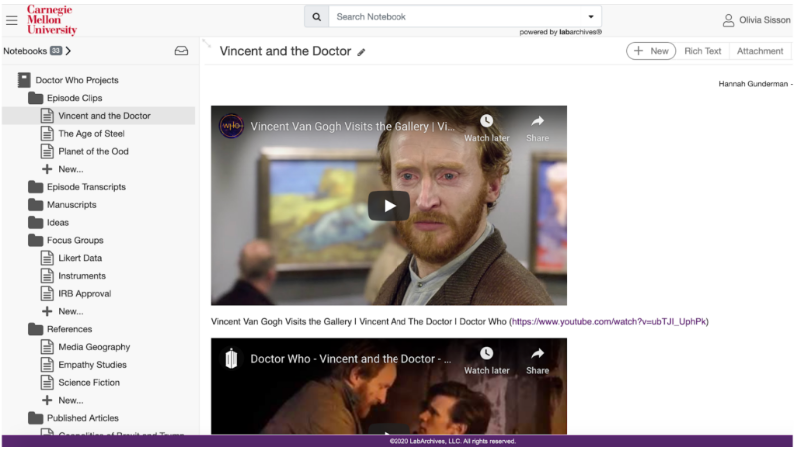
Videos: Movies and shows are what Hannah spends most of her time investigating. In the same way that a sociologist might observe human subjects and collect data points from interactions, Hannah observes life as it’s presented on screen. Video files are a crucial part of her research. Storing them in a paper notebook obviously isn’t an option. With LabArchives Hannah can store video files and clips directly on the notebook page. This makes it easy to keep corresponding video files, analysis and commentary in the same place.
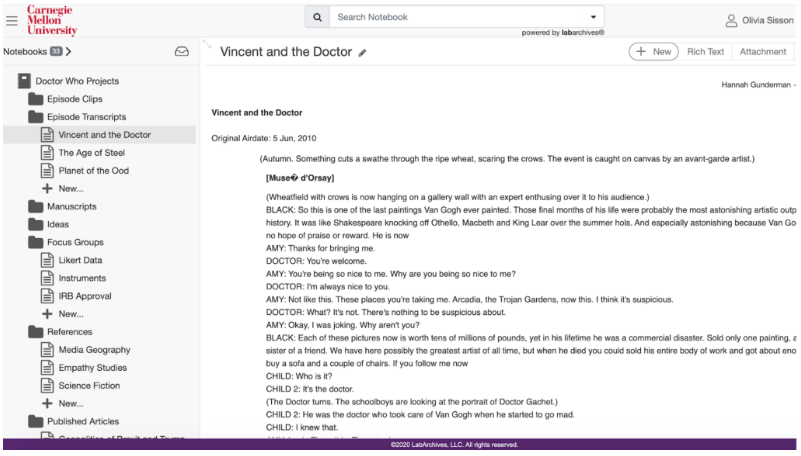
Files: Hannah uses transcripts and manuscripts from shows and movies to investigate language and messaging. These files can get bulky and keeping track of them is important. With just a few clicks she uploads them to her notebook and doesn’t have to worry about losing them…ever (nothing gets permanently deleted and all data is searchable within LabArchives). With an ELN, you never have to worry about misplacing your work.
Ideas: While research in any field is often rooted in analytical investigation and analysis, ideation and creativity is also a big part of it. Hannah keeps an idea log in her LabArchives notebook so that she can keep track of wandering thoughts that might become significant later on. Because she uses an ELN she can access her lab notebook from her phone or computer and jot down passing thoughts before they’re gone.
Big Data: Many researchers work with huge data sets. The same goes for humanities researchers. These files aren’t always easy to store or share but LabArchives accepts almost all file types. This makes it easy for Hannah and other researchers to keep track of everything related to their work and share it with collaborators when needed. Hannah is able to store all her files in LabArchives, even the files related to the automated data mining she’s done to investigate responses to the shows she studies.
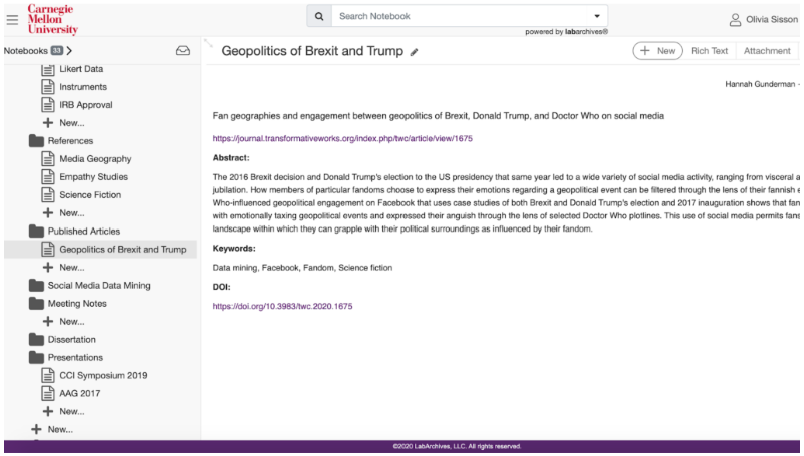
Publishing: When research and analysis are complete, it’s time to publish your findings. This phase, while exciting, is the point where organization and proper data management come into play in a big way. If data is strewn across desktop files, cloud storage systems, emails and/or paper notebooks collating everything in a way that suits publishing requirements can be a nightmare.
Hannah’s ELN takes care of all of these potential issues for her. Her work in LabArchives is organized, secure, properly attributed and completely searchable. If she did need to track down a certain piece of data even years down the line, she’d be able to find it quickly in LabArchives.
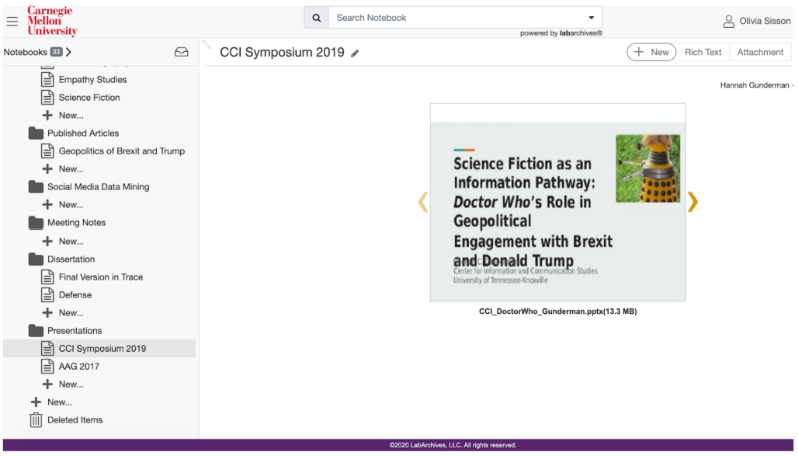
Presentations: Presenting your findings is another important part of research in any field. Hannah uses her ELN to create and store presentations, too. From data, to files, videos, images, papers and more ELNs make it easy to keep literally everything associated with your work in one secure place. Regardless of what you’re studying and what your data looks like you can organize it, store it and securely access it via an ELN.

 Record, organize, search and share your scientific data
 Streamline organizing, tracking and ordering lab inventory
 Manage and schedule lab equipment and resources
 Secure, compliant, government-approved solution