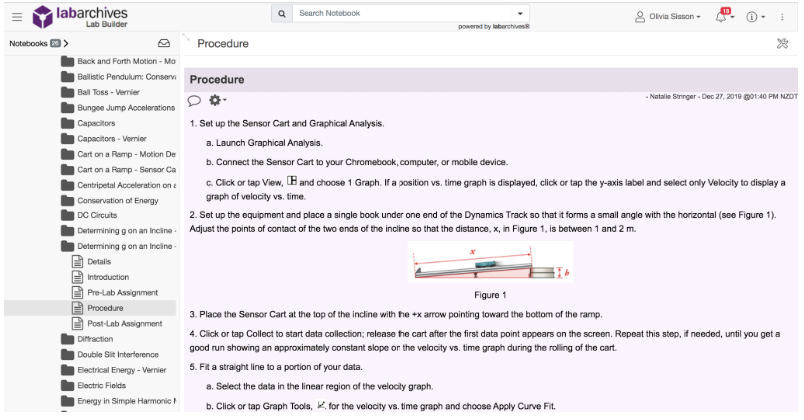
Most recently, we added Vernier experiments to Lab Builder. Vernier technology is designed specifically for education and their experiment library is no different.
Teaching a lab course = training the next batch of scientists. It’s a big job.
It takes careful planning and plenty of trial and error to design even one lab course experiment that teaches, tests and prepares students all at the same time.
That’s why we created Lab Builder, a course content library filled with proven content developed to help instructors achieve just that.
Lab Builder is anything but a static resource. We’re constantly adding more proven, ready-to-go course content that can be used in a range of lab courses.
Most recently, we added Vernier experiments to Lab Builder. Vernier technology is designed specifically for education and their experiment library is no different.
Vernier’s ready-to-use experiments are designed to help instructors achieve teaching and learning objectives and cover topics like physiology, biology, chemistry, physics, engineering and environmental science.
Vernier experiments in Lab Builder include details, introductions, pre lab assignments, procedures and post lab assignments – the complete package.
Even better still, all of these experiments are fully adaptable to different lab setups, equipment and objectives. The course packs, assignments and projects found within Lab Builder are too.
Vernier experiments in Lab Builder prepare students for professional research by incorporating the best data analysis software, digital lab notebook, equipment and curriculum.
Across research and technical teams, one instinct keeps winning: move fast and stay flexible,. Call it vibecoding. It feels efficient, modern, and cheaper, because there are no new systems to stand up and no hours lost to recordkeeping. But that feeling is an illusion. You cannot vibe your way to compliance, and the moment your work has to be shared, reproduced, or audited, the shortcut reveals itself for what it always was: a deferred expense with higher interest.
Tracking individual aliquots across experiments, team members, and storage locations can quickly become difficult. New Aliquot Management in LabArchives Inventory makes it easier to create aliquots in bulk, monitor each one individually, and connect samples directly to experimental data, all while maintaining complete traceability.
Every week, your shared research resources run nonstop. Instruments hum, grants fund the work, faculty publish. The engine is running. But could you produce, today, a single structured report showing which resources drove which grants and papers over the past three years? In most institutions, not without weeks of manual work, and likely with gaps. That is not a storage problem. It is an attribution problem, and it is quietly becoming a funding risk.
Most SaaS providers treat vulnerability management as a periodic compliance exercise. FedRAMP® does not. Achieving FedRAMP authorization required LabArchives to build a continuous, deeply scrutinized vulnerability management program covering everything from code and infrastructure to containers, databases, and penetration testing. The result is a stronger security posture that benefits not only government agencies, but every LabArchives customer.

 Record, organize, search and share your scientific data
 Streamline organizing, tracking and ordering lab inventory
 Manage and schedule lab equipment and resources
 Secure, compliant, government-approved solution