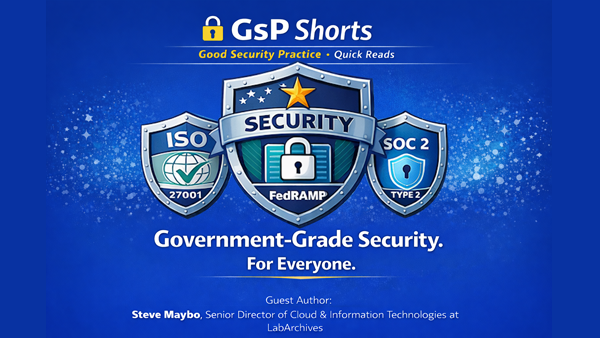
Author: Steve Maybo, Senior Director of Cloud & Information Technologies at LabArchives
GsP Shorts are intentionally quick reads — 3 minutes, tops. If that's still too much of a commitment, no judgment. Skip to the TL;DR. We won't tell anyone.
The Good-Better-Best Tiers of Cloud Security
For most any product, you choose a tier — good, better, or best. Cloud service providers are no different, and the same security tiers exist:
Good - “Alignment” with ISO 27001 or SOC 2 without actual audits — just trust us
Better - Actual ISO 27001 certification or SOC 2 attestation audits — you can trust us
Best - Adding a FedRAMP authorization to “Better” — you can REALLY trust us
What tier of security does your most important laboratory data deserve? LabArchives has chosen to provide the highest tier — not just for its government customers, but for all of them.
FedRAMP. The Best. For All.
No cloud service provider pursues FedRAMP authorization because they woke up one morning feeling extremely enthusiastic about learning endless acronyms, writing volumes of documentation, having more audits and working even harder. They pursue it because there is at least one government contract on the other side of a very long and ongoing compliance gauntlet that makes ISO27001 or SOC 2 look like amateur hour.
What nobody puts in the business case — and what genuinely surprises many — is that the security rigor required to achieve and maintain a FedRAMP authorization to attract government customers can often dramatically improve the same product’s existing environments that have been sold to everyone else, everywhere else, for years.
You're welcome, commercial and academic customers. You didn't even ask for a security upgrade. And it's free if your cloud service provider goes to FedRAMP extremes for the government — like LabArchives, which provides a FedRAMP-authorized ELN, inventory, and scheduling solution to the nation's medical research agency, the National Institute of Health (NIH).
Vulnerabilities Know No Boundaries
ISO 27001 and SOC 2 are absolutely important checkboxes for any cloud product’s security baseline. FedRAMP authorization for a LabArchives’ government cloud takes that “better” foundation and adds additional “best” government-grade security layers on top. LabArchives is a unique laboratory product that holds an ISO 27001 certification, a SOC2 Type 2 attestation, and a FedRAMP authorization.
Deeper FedRAMP audits, exhaustive documentation/reviews and continuous monitoring/auditing across code, containers, systems, databases, networks, and more can only scrutinize a cloud environment in ways that standard security checkboxes did not even want to think about.
FedRAMP-grade security scanning doesn't stop at the government product's door — its insights flow directly into all of our environments, which share many of the same pieces, parts, and people.
Government grade security. No matter where in the world you use LabArchives from. Why settle for better security when there is best security?
Hope Is Not a Security Model
Most SaaS products operate on a security strategy best described as “reasonable effort” — and reasonable effort leaves room for risk. FedRAMP has no interest in reasonable effort. It demands rigor, imposing strict remediation timelines that don't bend for quarterly roadmap commitments, delayed features, or competing priorities — security always comes first. Always.
Can’t make a FedRAMP finding deadline and you're filing formal documentation and presenting it to your government customer in a required monthly audit review. Even a low-risk finding that less stringent security standards might comfortably defer for months becomes an unacceptable moment that FedRAMP simply doesn't allow.
For LabArchives customers — whether they operate in a government environment or not — that standard means that no customers have to settle for a cloud provider's ”reasonable effort.”
The TL;DR
FedRAMP is a win-win for LabArchives’ government, commercial, and academic customers.
FedRAMP authorization is an externally enforced, independently verified, federally funded security upgrade for all product offerings. Government customers demand an exceptionally high bar for their FedRAMP cloud environments for good reasons. LabArchives’ commercial and academic customers can have their cloud environments no matter where it is in the world and reap many of the benefits of the LabArchives’ FedRAMP authorization. No charge. What benefits?
- FedRAMP-grade vulnerability scanning and detection
- Strict, non-negotiable vulnerability remediation timelines and management
- Hardened system configurations and elevated security standards
- Continuous monitoring, regular audits, and rigorous incident response standards
- More complete and rigorous disaster recovery testing processes
In a world where cloud data breaches are rising in frequency, cost, and impact, choosing better security isn't just smart — it's essential. But why settle for better when the best tier is available?
If you want to see how those standards translate beyond acronyms and checklists, take a look inside our Trust Center, where we provide a transparent view into our security practices, certifications, and controls:
Visit the LabArchives Trust Center
And if you're evaluating your current environment, our team is always available to discuss how we can help strengthen your organization’s data security posture.
When you compare laboratory data solutions, do you consider security as a critical feature for your valuable data? LabArchives does.
Does your laboratory data solution also adhere to higher FedRAMP standards for government customers? LabArchives does.
In the next GsP Shorts: Finding fewer vulnerabilities isn't always a sign of better security — sometimes it's a sign that you didn’t try too hard. Stay tuned for a future article on how LabArchives’ FedRAMP authorization sets a high standard for vulnerability detection — one that benefits all of our customers.

 Record, organize, search and share your scientific data
 Streamline organizing, tracking and ordering lab inventory
 Manage and schedule lab equipment and resources
 Secure, compliant, government-approved solution