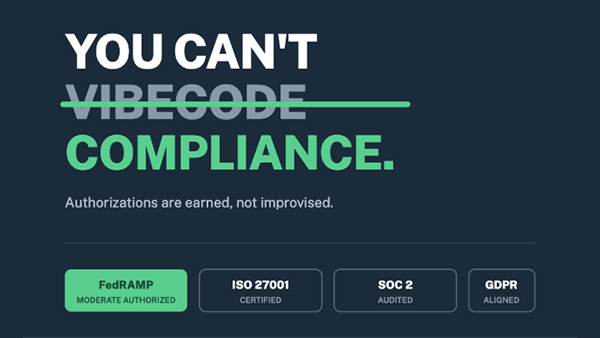
You Can't Vibecode Compliance
Why "move fast, document later" is a deferred expense with higher interest
Across research, development, and technical teams, one instinct keeps winning: move fast, stay flexible, figure it out as you go. Some people call it vibecoding. Others call it vibeworking, or just keeping things lightweight.
What is Vibecode?
vibe code (vīb kōd) vt. -cod'ed, -cod'ing; vi. ⟦blend of vibe & code⟧ 1 to generate code by giving an AI system casual prompts rather than writing it oneself 2 to build software this way without formal training, a practice spreading fast across industries, including the sciences and research markets —n. 1 code so produced —vibe cod'er n. one who vibe codes —vibe cod'ing n. the practice of generating software through casual AI prompting, often prioritizing speed over security architecture and engineering discipline —vibe'-cod'ed adj. produced this way; lacking structural review
usage Vibe coding's appeal is accessibility: non-coders can build tools from natural-language prompts alone. That ease has a cost, code made without review often lacks the access controls and audit trails compliance requires, trading speed for real security risk.
Whatever the label, the appeal is the same. It feels efficient. It feels modern. And it feels cheaper, because there are no new tools to buy, no formal systems to stand up.
That feeling is real. The savings are not. You cannot vibe your way to compliance, and trying to will cost you more later than doing it right would have cost you now.
The cost-saving illusion
On the surface, working on vibes looks like sound financial discipline. No investment in structured platforms. Minimal process overhead. Faster time to "something done." Less training required. In the short term, it genuinely reduces friction and spend.
But it does not remove the cost. It defers it. And deferred costs in regulated and research environments accrue interest. When the bill finally arrives, it is far larger than the invoice you avoided at the start.
When "cheap" becomes expensive & risky
The illusion holds right up until your work has to leave your own head. The moment it needs to be shared, validated, reproduced, or audited, the gaps become visible all at once.
Teams that skipped the structure end up spending hours, sometimes days, reconstructing steps nobody recorded, hunting for the "latest" version of a file, explaining decisions that were never written down, and trying to prove data integrity after the fact. What was booked as savings turns into lost productivity, compliance exposure, and delayed outcomes.
What vibe-driven work actually looks like
It helps to name the pattern honestly:
- Notes scattered across tools, or never written down at all
- File names like final_v3_REAL_final.xlsx
- Processes that live in one person's memory
- No consistent version history
- A standing promise to "clean it up later"
The trouble is that "later" almost always arrives at the worst possible moment, when the stakes and the scrutiny are highest.
Compliance does not accept shortcuts
Regulated and research environments set the bar plainly. Document what you did. Preserve how it changed. Store it securely. Make it reproducible. The NIH Data Management and Sharing Policy, in effect since 2023, expects researchers to plan for data preservation and sharing from the start of a project rather than assemble it in retrospect. Institutional review boards, funders, and journals apply the same logic in their own ways.
None of these expectations can be satisfied retroactively. A reconstructed audit trail is not an audit trail. A version history recreated from memory is a guess. Traceability, once lost, cannot be manufactured.
The self-asserted trap
Here is the part that vibe-driven work gets most wrong. Compliance is not something you declare about yourself. It is something an independent party verifies.
Anyone can put "secure" or "compliant" on a slide. Anyone can claim their process holds up. The distinction that actually matters, the one auditors, federal agencies, and serious partners look for, is whether that claim has been checked by someone outside the organization making it. A self-asserted control is a vibe. An independently verified authorization is a fact.
This is why "in process" and "aligned with" are not the same as "authorized" and "certified." When your data has to stand up to a federal review, the reviewer does not grade the intention. They check the record.
The real cost of fixing it later
Lean on informal workflows too long and the consequences compound: failed or delayed audits from missing trails, time-intensive rework to recreate documentation, results that cannot be reproduced, publications and approvals held up, and mounting institutional risk. By that point you are not buying a tool. You are paying for cleanup, correction, and the slow work of rebuilding credibility.
Structure is not overhead. It is insurance.
There is a persistent belief that structured systems slow teams down and add cost. In practice they do something more valuable. They stop expensive problems before they start. Good structure does not replace flexibility. It gives flexibility to a set of guardrails, so that speed early in a project does not become liability later.
Where LabArchives changes the equation
This is where a platform like LabArchives moves the conversation from cost to value. Instead of forcing a choice between "fast and cheap" and "structured and compliant," it delivers both:
- Built-in audit trails capture every change automatically, as it happens
- Centralized documentation replaces scattered notes and lost files
- Standardized workflows reduce variability across people and teams
- Secure, compliant infrastructure aligns with regulatory expectations by design
And critically, the platform's compliance posture is verified, not asserted. LabArchives holds FedRAMP Moderate Authorization that is officially listed on the FedRAMP Marketplace, and maintains SOC 2, ISO 27001, GDPR-aligned data protection, and NIST 800-53 based controls. These are independently confirmed, which is precisely the standard a self-declared "compliant" workflow can never meet.
Most important of all, LabArchives removes the need to "clean it up later," because the work is documented correctly while it is being done.
From short-term savings to long-term value
Vibecoding is not wrong in itself. It is genuinely useful for early exploration, brainstorming, and rapid iteration, where the goal is to learn quickly and nothing has to be defended yet. The problem begins when it becomes the default in environments that demand accountability. At that point it stops being efficient and starts being risky. The apparent shortcut reveals itself for what it always was: a deferred expense with higher interest.
Final thought
Creativity gets you started. Speed gets you moving. Structure is what protects the work, and the organization behind it, when the questions get hard.
Because in the end it is not only about getting the work done. It is about being able to prove it.

 Record, organize, search and share your scientific data
 Streamline organizing, tracking and ordering lab inventory
 Manage and schedule lab equipment and resources
 Secure, compliant, government-approved solution