Implementation: What it Looks Like When it’s a Breeze
Columbia University’s LabArchives enterprise license ensures that everyone on campus has access to the platform. Researchers, PIs (primary investigators), lab managers, instructors, students, post grads
Columbia University’s LabArchives enterprise license ensures that everyone on campus has access to the platform. Researchers, PIs (primary investigators), lab managers, instructors, students, post grads – all can leverage LabArchives for their unique purposes.
But this alone doesn’t mean that they will.
Last month, LabArchives team members travelled to Columbia to do what they do best – support implementation. Their tried and true implementation protocol usually looks something like this:
Educate potential users + support existing users + get user feedback + improve product + REPEAT
After four years of working together, Columbia and LabArchives both know that collaboration at every stage is the secret to wide spread usage and end user success. It’s an ongoing journey that, with the right approach, can even be fun (see below).
While LabArchives is already available to all Columbia University members, most need to feel informed about the platform and supported in their usage, before committing to it. Usage is, after all, what makes an enterprise investment worth it.
On the day of the forum, the LabArchives team worked with a PI had become frustrated with Evernote, their chosen documentation platform. Without timestamps or versioning, who had done what with the data had become very unclear.
The researchers were also frustrated. They couldn’t access the data from more than one device without an Evernote upgrade. After a quick in-person demo, the lab realized that Columbia already offered a total solution: LabArchives. On the ground help was exactly what they needed to transition to a platform truly designed for their needs.
At the forum’s Health Sciences Library open house, LabArchives educated researchers and students alike on the platform’s benefits. Users can access their work anytime, anywhere and from any device. LabArchives fits in with increasingly digital lifestyles and gives students a leg up when it comes time to apply for jobs in ‘real world’ labs.
LabArchives team member, Hannah Clark, also hosted several training sessions for fledgling users and a lunch-and-learn session at Butler Library.
These events all gave end users a chance to buy-in on their own terms and get started with LabArchives in real time. Showing potential users how they might benefit, versus telling them to change their workflows lays the groundwork for an enthusiastic user community.
Supporting existing users
While at Columbia, LabArchives also worked with labs who had been comfortably using the platform for quite some time. One such lab had started using some of the platform’s more advanced widgets, like the freezer box, to manage inventory. Hannah held a mini widget workshop with this group to help them leverage these tools even further.
These tailored workshops also gave LabArchives a chance to educate existing users on new releases and upcoming developments. With these groups, Hannah shared information on the recently released SnapGene integration and upcoming scheduler and inventory capabilities.
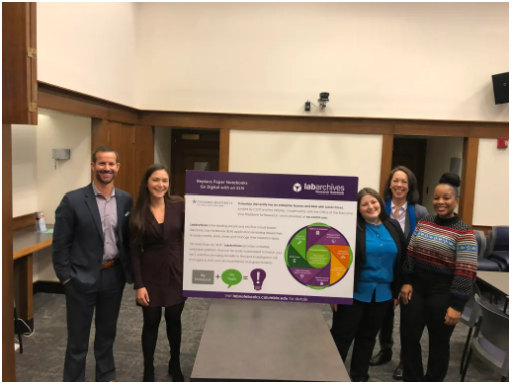
LabArchives team members with Columbia users.
Getting user feedback
End users are LabArchives greatest source of intelligence when it comes to understanding how the platform actually works on the ground. Columbia chemistry professor, Joseph Ulichny, sat down with the team to discuss how he has used the platform for teaching, what has worked, what hasn’t and so on. His experiences and his ideas for new developments will inform LabArchives roadmap and product evolution.
These second and third phases of implementation are all about sharing knowledge. LabArchives educates existing users on how to best leverage the platform and users educate LabArchives on how to improve the overall experience. Users come to understand that real people are available to support them within the platform and it serves their needs better and better over time. It’s a positive feedback loop that really works.
And what’s next?
More of the same high-quality, implementation execution. As Hannah put it…
“More usage! More webinars and training sessions. Working with the library and Research Services on institutional policy, guidance documentation and promoting LabArchives across campus. Maybe a few more “advanced” sessions to cover things like widgets. Possibly creating templates and best practices recommendations for Columbia users, too!”
Until next time, Columbia!
Thanks to everyone at Columbia who helped plan this day including Columbia University Libraries and Research Services. Especially Halayn Hescock, Senior Director of Research Services, as well as Tshakeesha Ming, Jeremiah Trinidad-Christensen, Sameea Baig and Michelle Benson.
Important research information doesn’t always start digitally. Handwritten notes, annotated figures, diagrams, and scanned documents can contain valuable details that are difficult to find once they’re stored as images. With the new Text & Handwriting Extraction feature for LabArchives ELN, Enterprise customers can extract text from uploaded images and PDFs, making that information searchable alongside the original file.
Across research and technical teams, one instinct keeps winning: move fast and stay flexible,. Call it vibecoding. It feels efficient, modern, and cheaper, because there are no new systems to stand up and no hours lost to recordkeeping. But that feeling is an illusion. You cannot vibe your way to compliance, and the moment your work has to be shared, reproduced, or audited, the shortcut reveals itself for what it always was: a deferred expense with higher interest.
Tracking individual aliquots across experiments, team members, and storage locations can quickly become difficult. New Aliquot Management in LabArchives Inventory makes it easier to create aliquots in bulk, monitor each one individually, and connect samples directly to experimental data, all while maintaining complete traceability.
Every week, your shared research resources run nonstop. Instruments hum, grants fund the work, faculty publish. The engine is running. But could you produce, today, a single structured report showing which resources drove which grants and papers over the past three years? In most institutions, not without weeks of manual work, and likely with gaps. That is not a storage problem. It is an attribution problem, and it is quietly becoming a funding risk.

 Record, organize, search and share your scientific data
 Streamline organizing, tracking and ordering lab inventory
 Manage and schedule lab equipment and resources
 Secure, compliant, government-approved solution